methods / free-vpn-tiers
Free VPN tiers: what free plans really give you
Short answer
A few free VPN tiers are honest limited versions of paid products - Proton VPN Free (unlimited data, one device, no ads, no logs), Windscribe, PrivadoVPN and TunnelBear. Everything else with unlimited promises is likely monetizing your traffic. Free means limits, not freedom from the bill.
"Free VPN" is the most abused phrase in this field - and there are still a handful of free tiers that are exactly what they claim: limited versions of paid services, run as real businesses, safe to use for reading and everyday unblocking. The skill is telling the two groups apart, and the difference is one question: who pays for the servers? [5]
The four funding models
Freemium. A real paid product with a limited free tier: fewer countries, one device, capped data - designed to convert you to a subscriber. The provider's incentive is your upgrade, not your data. This is the only free-tier model worth building habits on.
Ad-funded. Free use paid by ads or sponsorship. Workable, with honest friction: ads in the app, queues for free servers. Psiphon runs this model openly.
Bundled. A VPN bolted onto antivirus or a browser. Harmless to ignore, but nobody builds world-class VPN infrastructure as a checkbox feature.
Data harvesting. "Unlimited" and "free" with no visible business - the traffic itself is the product: resold bandwidth, injected ads, harvested behavior. EFF's VPN guidance exists largely to steer people away from this group [5].
The free tiers that pass the test
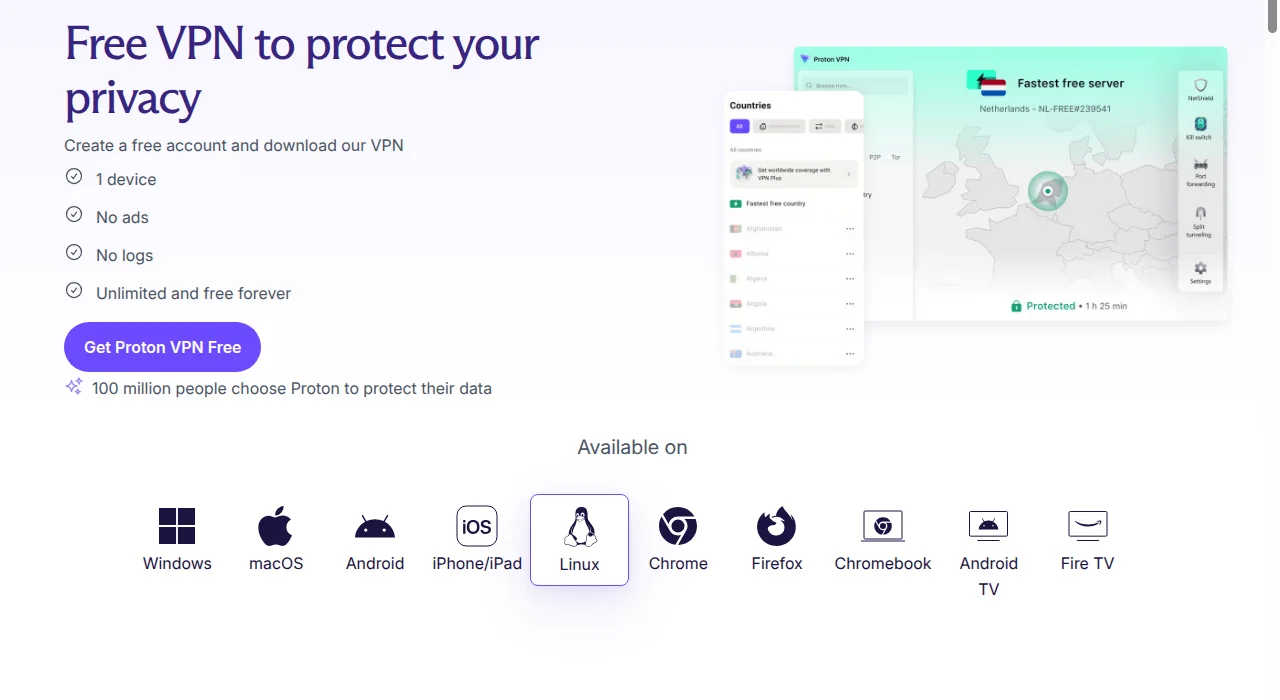
- Proton VPN Free - the standout honest free tier. Proton's own page states the terms plainly: one device, no ads, no logs, unlimited data on a permanent free tier, with the same open-source, independently audited clients as the paid product [1]. The free tier limits you to a small set of countries on shared, sometimes congested servers - that is the honest trade.
- Windscribe Free - a monthly data allowance (historically around 10 GB; check the current number on their free page, they have adjusted it over time) across a wider set of locations than most free tiers [2]. Solid second choice when Proton's countries do not include what you need.
- PrivadoVPN Free - a data-capped free tier with a decent country spread [3]. Fine as a second slot on a different provider.
- TunnelBear Free - a small monthly allowance (a couple of GB) with excellent app design; good for occasional use, too small for daily driving [4].
- Cloudflare WARP - not a VPN in the classic sense, but a free tunnel that fixes DNS and SNI-level blocks with no account at all [6]. Our WARP guide explains when it beats a free VPN.
Our live snapshot table below shows the current offers we track, with logging evidence and entry pricing - the same columns we use in the full buying guide:
| VPN | Logging evidence | From | |
|---|---|---|---|
| hide.me | audit | $3.04 | Visit hide.me |
| Mullvad VPN | court-proven-nologs | $5.65 | Visit Mullvad VPN |
| CactusVPN Smart DNS | audit | $3.96 | Visit CactusVPN Smart DNS |
| Amnezia VPN (self-hosted with obfuscation) | audit | $5 | Visit Amnezia VPN (self-hosted with obfuscation) |
| IVPN | policy-only | $5 | Visit IVPN |
What free tiers realistically buy you
Free tiers are for access, not for lifestyle:
- Works well: getting past school, office and ISP filtering; reading news; occasional geo-sensitive browsing where a free server happens to be in the right country; covering a laptop on hostile Wi-Fi.
- Does not work well: streaming (free server capacity is thin and contested), torrenting (often blocked or throttled), anonymity (one shared exit for thousands of users), and anything where the provider itself should not learn about you - a free account tied to your email is an identity, not a cloak [5].
One structural point: free tiers deliberately share a small number of exits, so many people appear from the same IP. Sites respond to that with captchas and blocks. If a specific site fights you daily, that is the signal to upgrade - or to run your own VPN on a VPS, which costs about as much as a coffee and has one user: you.
How to spot the trap before it costs you
- Read the business line. If there is no paid product, no ads shown honestly, and no nonprofit - the product is you [5].
- Beware browser extensions and "unlimited free" mobile apps with hundreds of millions of installs. The permissions alone (all traffic through the extension) make them data business by design.
- Check the company's own stated limits. Honest providers state device counts, data caps and country lists on the free page, like Proton does [1]. Vagueness is a red flag.
- Never trust a free VPN with logins. Whatever the tier, treat the tunnel as a pipe, not a bank vault: the provider sees the destination of your traffic even when it cannot read it [5].
A legal note, as everywhere on this site: using a VPN is legal in most countries, restricted or monitored in some, and managed networks have their own rules. This guide is information, not legal advice [5].
FAQ
Is a free VPN safe to use?
A free tier of a real paid provider is safe for everyday unblocking - the provider earns from upgrades, not your data. A free VPN with unlimited promises and no visible business is usually monetizing your traffic, which is the exact opposite of safety.
Which free VPN has no data limit?
Proton VPN Free states unlimited data on its free plan, with one device, no ads and a no-logs policy - the most generous honest free tier at the time of writing. Other providers like Windscribe and PrivadoVPN work with monthly data caps; check the current numbers on their free pages.
Why is the free tier so slow compared to paid?
Free tiers deliberately share a small number of servers among many users, and paid customers get priority. The congestion is the upgrade incentive - the same reason free server locations are few.
Can I use a free VPN for streaming or torrenting?
Usually not: free tiers lack the capacity for streaming and commonly block peer-to-peer traffic. If that is your use case, a paid plan or your own VPN on a rented server is the realistic path.
What is wrong with free VPN browser extensions?
An extension routes your browser traffic through the extension publisher's servers, which makes the publisher a full man-in-the-middle for your browsing. Extensions with unlimited free promises are a data-harvesting pattern, not a business.
Is WARP a better free option than a free VPN?
For network-level blocks, often yes - it is free without an account and rides Cloudflare's network. It has no exit-country picker, so site-side geo blocks stay. Use WARP for filtering, a free VPN tier for exits, a paid VPN for both.